Guide
How to Write Wedding Vows: Templates and Tips
By Sarah Mitchell · Updated 2026-03-28
 Two people share an emotional, heartfelt moment during the vow exchange.
Your wedding vows are the most important words you'll ever say to your partner. They should be personal, heartfelt, and unmistakably yours. This guide walks you through writing vows that reflect your relationship, make your guests laugh and cry, and create a moment you'll both treasure forever.
Table of Contents
- Why Your Vows Matter
- How to Start Writing Your Vows
- Key Elements Every Great Vow Should Include
- Wedding Vows Templates for Every Style
- Common Vow Mistakes to Avoid
- Tips for Delivering Your Vows
- Vow Examples: Real Couples Share
- Advanced Vow Writing Techniques
- FAQs About Wedding Vows
Why Your Vows Matter
Your wedding vows are more than ceremonial words—they're a public declaration of your commitment. Unlike your first kiss or the exchange of rings, your vows are entirely within your control. They set the emotional tone for your entire ceremony and become a memory your guests will remember for years.
Well-written vows do three things: they make your partner feel seen and loved, they tell your story as a couple, and they establish what you're committing to in this marriage.
The Science Behind Vow Writing
Research from the Journal of Couple & Relationship Therapy found that couples who wrote personalized vows reported higher marital satisfaction than those who used completely generic vows. But there's a balance—vows that are too personal or inside-joke heavy can alienate your guests, while vows that sound copied from a greeting card feel hollow.
The sweet spot? Personal without being mysterious. Funny without being mean. Touching without being saccharine.
Why Personalized Vows Matter for Your Relationship
When you write your own vows, you're doing something crucial: you're articulating what this marriage means to you. Marriage researchers have found that couples who take time to write personalized commitments tend to:
- Communicate more openly throughout their marriage
- Have higher emotional intimacy scores
- Report greater relationship satisfaction after 5+ years
- Feel more connected during difficult times
This isn't magic. It's clarity. By writing your vows, you're forced to get clear on what matters most, what you're promising, and what you hope to build together.
How to Start Writing Your Vows
Step 1: Ask Yourself Five Questions
Before you write a single word, answer these:
-
What specifically do you love about your partner? Not "you're kind" but "the way you make tea for my mom when she visits even though she always criticizes something."
-
What moment made you realize this was forever? Was it a small gesture? A difficult time you got through together? A moment of pure laughter?
-
What do you promise to bring to this marriage? Loyalty? Humor? Growth? Stability? Name three specific promises.
-
How do you want to challenge your partner (in a good way)? "I promise to push you to take that pottery class you've been talking about for three years."
-
What does forever look like to you as a team? Adventures? Quiet Sunday mornings? Building something together? Raising kids? Traveling? Growing old?
Step 2: Brain Dump Everything
Set a timer for 10 minutes. Write down every memory, inside joke, embarrassing moment, dream, and feeling about your partner and your relationship. Don't edit. Don't judge. Just let it flow.
This is not your vow yet. This is the raw material. Many professional wedding writers recommend this technique because it bypasses your inner critic and lets you access genuine emotion.
Step 3: Find Your Core Three
From your brain dump, identify the three most important themes:
- A memory or moment that defines your relationship
- A quality of your partner that makes your heart full
- A promise or commitment that matters most to you
These three elements will form the backbone of your vow. Everything else is decoration.
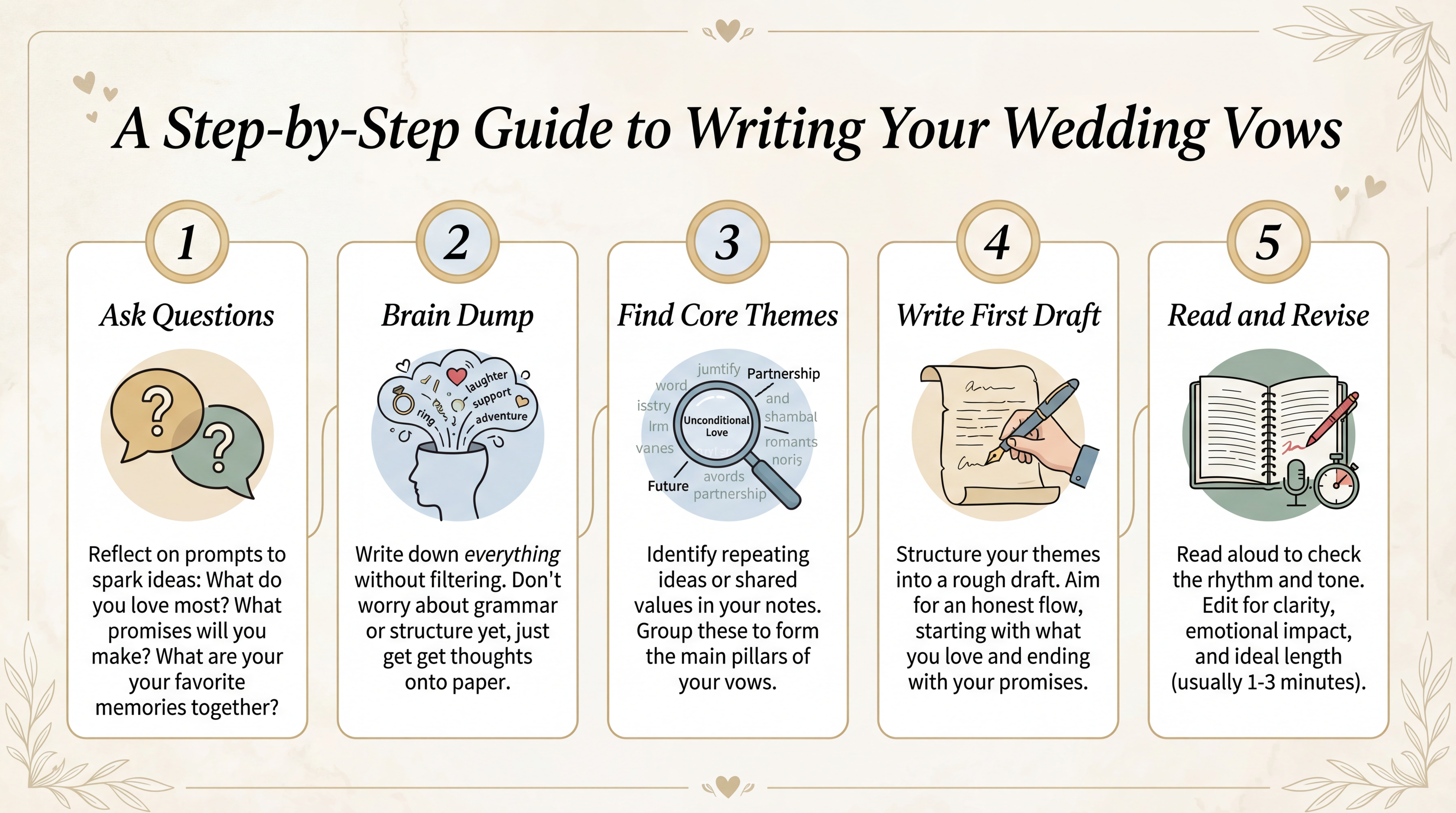 Follow these five steps to transform your raw feelings into structured, heartfelt vows.
Step 4: Write Your First Draft
Using your core three themes, write your first draft without editing. Just get the words down. Don't worry about rhyming, flowery language, or perfect phrasing. Aim for honest over pretty.
Step 5: Read Aloud and Revise
This is crucial: read your vows out loud. You'll immediately notice:
- Words that are hard to pronounce
- Phrases that sound awkward when spoken
- Repetitive words you didn't notice reading silently
- Places where you need to breathe
Revise based on what you hear, not what you see.
Key Elements Every Great Vow Should Include
1. The Hook (First 30 Seconds)
Start strong. This grabs attention and sets the tone. Options:
- A specific memory ("The first time we met, you spilled wine on my white dress and apologized for ten minutes...")
- A funny observation ("Everyone warned me that marrying my best friend would be weird. They were right. You steal the blankets.")
- A bold statement ("I never believed in soulmates until I met you.")
- A surprising fact ("I was completely not looking to date anyone when you walked into my life...")
2. Why This Person (The Middle)
This is where you go deep. Tell your guests (and your partner) what you specifically love about them. Not generic qualities, but specific behaviors:
- "The way you listen without trying to fix things"
- "How you laugh at your own jokes even when nobody else does"
- "That you drove three hours to help my sister move, even though you had work the next day"
- "The way you call your mom every Sunday"
- "How you remember my coffee order from the first day we met"
This section should be 40-50% of your vow. Don't rush it. These details are what make your vows unmistakably about your specific partner.
3. Your Promises (The Commitment)
What are you actually promising? Beyond the basic "love, honor, cherish" framework, get specific:
- "I promise to be your cheerleader when you doubt yourself"
- "I promise to laugh at your terrible dad jokes, even the ones that don't land"
- "I promise to grow with you, not beside you, but together"
- "I promise to show up, even on days when showing up is hard"
- "I promise to build a safe space where you can be completely yourself"
- "I promise to fight fair and never go to bed angry"
Make 3-5 promises, each specific and actionable.
4. A Nod to the Future (The Vision)
Paint a picture of your future together. Keep it grounded (not a fairytale), but positive:
- "I can't wait to build a home with you"
- "I'm excited to see what adventures we create together"
- "I'm ready to become the people we're going to grow into"
- "I want to grow old with you, laugh wrinkles and all"
5. The Closer (Last 30 Seconds)
End strong. This is what they'll remember. Options:
- Return to your opening theme
- A one-liner that's undeniably you
- A simple, powerful statement
Bad closer: "And that's why I love you." Good closer: "That's why I'm marrying you today, and why I'd marry you all over again tomorrow." Better: "I can't wait to spend the rest of my life becoming the best version of myself for you, and for us."
Wedding Vows Templates for Every Style
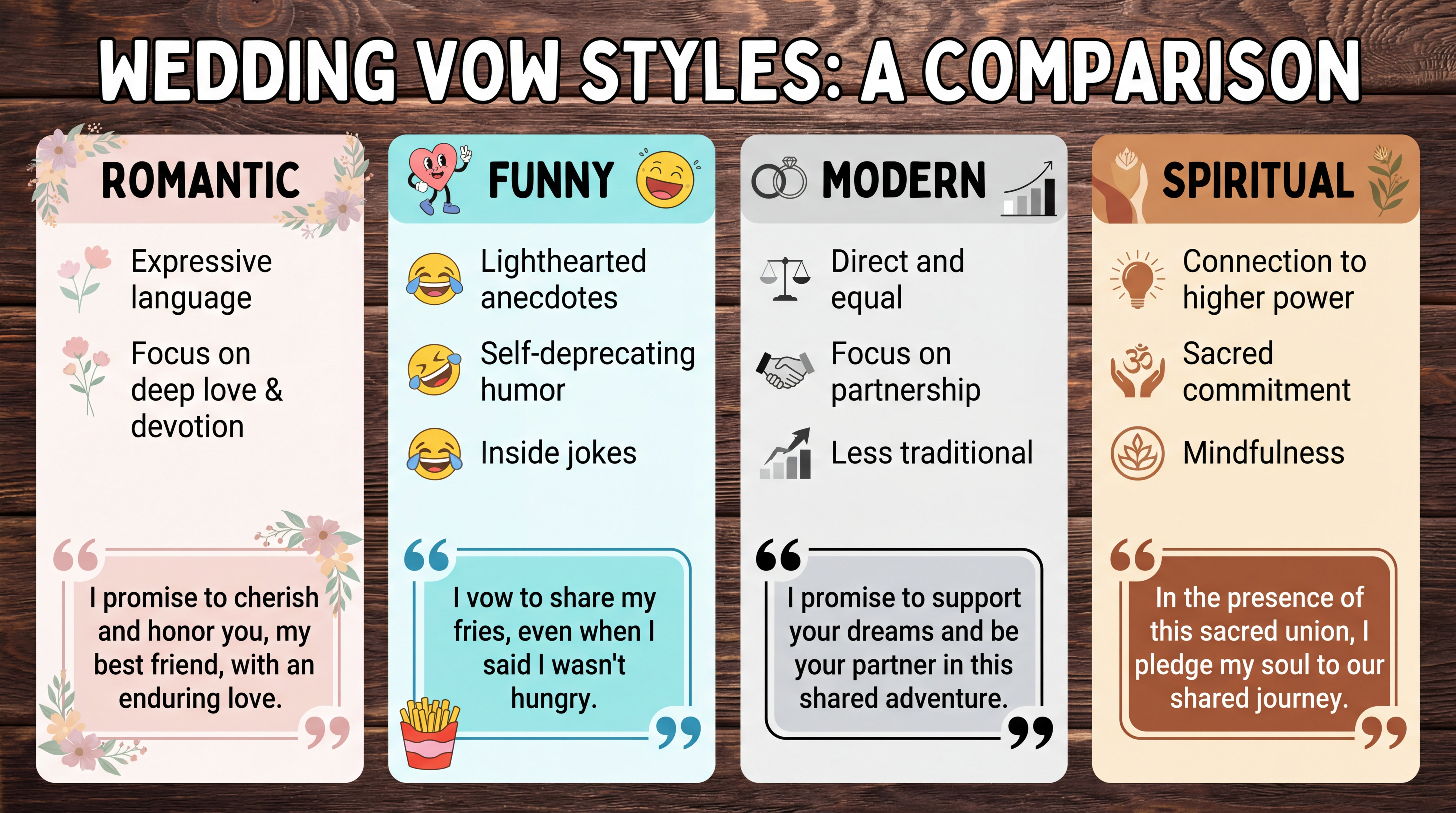 Choose a vow style that matches your personality and relationship dynamic.
Template 1: Classic + Romantic
I [Name], take you [Partner's Name] to be my [spouse/husband/wife/partner]. From the moment I met you, I knew you were different. You make me want to be a better version of myself. I promise to love you on the good days and support you on the hard days. I promise to laugh with you, cry with you, and build a life with you that's even more beautiful than I imagined. I promise to be your partner in everything—adventure and routine, celebration and challenge. I choose you today, and I'll choose you every day after. I love you completely.
Template 2: Funny + Heartfelt
I [Name], take you [Partner's Name] to be my [spouse/husband/wife/partner]. When I first met you, I thought you were out of my league. I still think that most days. You're funny, talented, and somehow you actually like spending time with me. I promise to make you laugh even when you're angry at me (which, let's be honest, is often). I promise to be your biggest fan, your strongest supporter, and the person who never stops believing in you. I promise to listen when you need to vent, even if it's about reality TV for the hundredth time. Most importantly, I promise to love you fiercely, completely, and forever. Thank god you said yes.
Template 3: Modern + Direct
I [Name], stand before you today with one simple intention: to love you completely. Not because society tells me to, not because of tradition, but because you are the person I choose. I choose your ambition, your curiosity, and your weird sense of humor. I choose to be your partner in building something meaningful. I promise to grow with you, to challenge you gently, and to support your dreams as fiercely as my own. I promise to show up as my whole, authentic self—imperfect and human. And I promise to do the same for you. Let's build something extraordinary together.
Template 4: Spiritual + Intentional
I [Name], come before you and this community to dedicate myself to you. This union is sacred to me. I promise to honor your spirit, celebrate your purpose, and stand beside you as we grow toward our highest selves. I commit to being a source of love and stability, to nurturing our relationship with intention and presence. I promise to listen with my whole heart, to forgive with grace, and to love you with depth that transcends circumstance. May our love be a light in this world.
Template 5: Practical + Loving
I [Name], take you [Partner's Name] as my [spouse/partner]. I promise the practical things: to pay the bills on time, to remember your important dates, to show up. But I also promise the bigger things: to be curious about who you are becoming, to support your growth even when it's uncomfortable, and to never take for granted the fact that you chose to do this life with me. I promise to be steady, to be honest, and to love you even on the days when love feels like work rather than magic. Because that's what partnership is—showing up even when the magic fades.
Common Vow Mistakes to Avoid
| Mistake | Why It Doesn't Work | Better Approach |
|---|---|---|
| Reading from a greeting card or website verbatim | It doesn't sound like you. Your partner knows what a generic vow sounds like. | Use templates as inspiration, but write in your own voice. |
| Inside jokes nobody else understands | Half your guests will be confused. Your vow becomes unclear. | Explain the setup briefly. "Three years ago when we first met, [context]..." |
| Mentioning exes | Even in a "I'm so glad I'm not with them" way, it's awkward. | Focus forward, not backward. |
| Making promises you can't keep | "I promise to never disagree with you." Unrealistic and sets you up for failure. | Promise effort and intention, not perfection. |
| Going too long | Longer than 2-3 minutes? You're losing people. | Aim for 1-2 minutes. Every word should matter. |
| Making it all about you | "I'm so lucky you chose me..." Yes, but what about what you're giving? | Balance how you feel with what you're committing to. |
| Being too crude or risky | Even if you think it's funny, some relatives will cringe. | Keep it PG-13. You can be funny without being crude. |
| Avoiding emotion entirely | All jokes, no heart. Your guests won't feel the significance. | Mix humor with genuine feeling. |
| Being vague or generic | "I promise to love you" could apply to anyone. | "I promise to love you even when you're grumpy in the morning" is specific to them. |
Tips for Delivering Your Vows
Before the Wedding Day
Practice out loud. Don't just read silently. Hear yourself say the words. You'll find awkward phrasing or words that don't roll off the tongue. Professional wedding speakers recommend practicing 5-10 times.
Time yourself. Use your phone to record yourself. You want 1-2 minutes, not 5. Most people underestimate how long they take when emotional.
Memorize what you can. You don't need to memorize word-for-word, but you should know the main beats. This way you can look at your partner instead of reading the entire time.
Have a backup plan. Write your vows on a small card in case nerves make you forget. But try to minimize looking at it. Consider large font so you can glance quickly if needed.
Practice with an audience. Stand in front of your best friends or family and deliver your vows once. Hearing their reactions will help you understand the impact.
During the Ceremony
Breathe. If you feel tears coming, pause. Take a breath. The tears are okay—they show this matters. Your officiant expects this.
Make eye contact. Yes, you're emotional. Yes, it's vulnerable. But your partner needs to see you. This is for them. Try to look at their eyes, not their entire face.
Speak slowly. When you're nervous, you rush. Deliberately speak slower than feels natural. Pause between sentences.
Smile. Even through tears, smile at the person you're marrying. This is joy. Your whole body should communicate love, not just your words.
Don't apologize for your emotions. "Sorry, I'm getting emotional." You don't need to explain. Your guests understand. The emotions are the point.
If you completely lose it: Stop. Take a moment. Your officiant or partner might step in. It's okay. Breathe. And when you're ready, continue. No one expects perfection.
 Emotional authenticity is the most important element of powerful vows.
Vow Examples: Real Couples Share
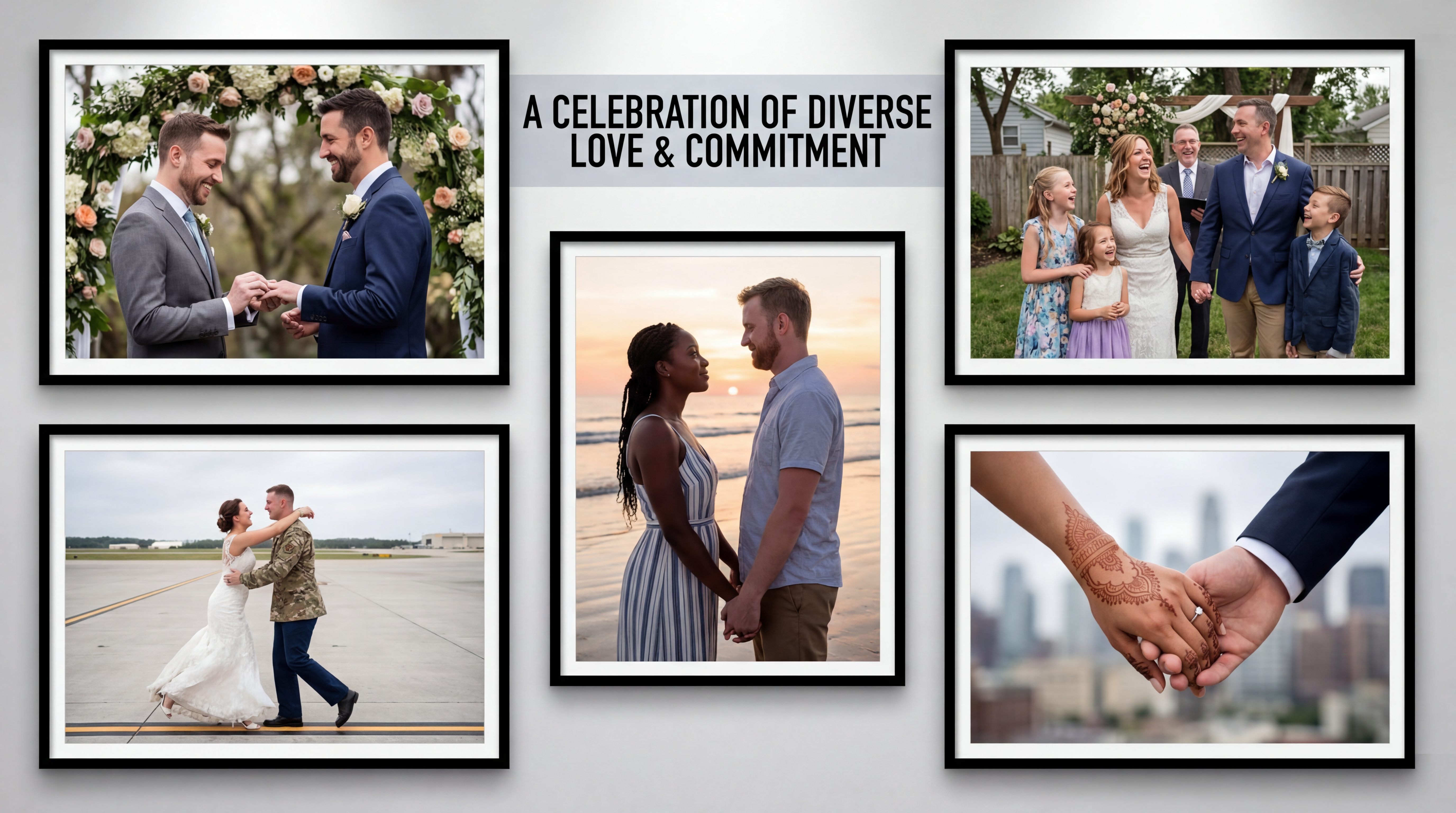 Love comes in many forms, and so do vows that honor it.
Example 1: Same-Sex Couple (2 Years Together)
I [Alex], take you [Morgan] to be my husband. When we first met, I wasn't looking for anything serious. But you had a way of making me want to be more serious about life. You push me to be braver, kinder, and more myself. I promise to be your biggest supporter as you chase your dreams. I promise to love the little versions of you—the tired version at 6 AM, the grumpy version when you haven't had coffee, the silly version that only I get to see. I promise to build a home with you, a life with you, a family with you. I'm so grateful I get to call you my husband. I love you.
Example 2: Second Marriage (Both Have Kids)
I [Jennifer], take you [Michael] to be my husband. This isn't our first time at the altar, and maybe that makes this even more meaningful. We both know what doesn't work. We both know what we're looking for in a partnership. With you, I found it. I promise to be a partner to you and a support to your children. I promise that our blended family will know they are loved and secure. I promise to choose you, even when it's complicated, even when there are logistics and hurt histories. I promise to build something new and beautiful with you. I'm ready for this next chapter.
Example 3: Childhood Friends to Lovers (8 Years Together)
I [James], take you [Rachel] as my wife. You were my best friend before you were my partner. You still are. I've known you my entire adult life, and I can't imagine my life any other way. I promise to keep laughing with you, traveling with you, and building dreams with you. I promise to honor our friendship as much as our romantic love. I promise that even when we argue, even when things get hard, I'll remember that you're my person. You've always been my person. I love you completely.
Example 4: Long-Distance to Forever
I [Sophie], take you [David] to be my husband. We spent three years in different cities, different time zones, different countries. And you know what I learned? That this is real. What we have is real. I promise that the hard days—the lonely nights, the missed moments, the sacrificed weekends—were all worth it because you were worth it. I promise to never again take for granted how lucky I am to wake up next to you. I promise to build a home that feels safe, that feels like us. I promise to keep choosing you, just like I chose you every single day when we were apart.
Advanced Vow Writing Techniques
Technique 1: The Bookend Structure
Start and end your vows with the same theme or phrase. This creates a sense of completion:
Opening: "When I met you, I thought love was something that happened to you." Closing: "Now I know love is something you choose, every single day. And I choose you."
Technique 2: The Metaphor
Use one consistent metaphor throughout your vows:
- Journey: "This is the adventure I want to go on with you"
- Building: "We're building something beautiful, brick by brick"
- Garden: "I promise to nurture what we grow together"
- Home: "You're where I come home to"
Technique 3: The Progressive Structure
Move through time in your vow:
- Past: How you met and what you learned about each other
- Present: What you feel and why you're here today
- Future: What you're committing to and what you hope to build
Technique 4: The Question + Answer
Ask rhetorical questions that you then answer:
"Do I know marriage will be easy? No. Do I know it'll always feel like this? Probably not. But do I know I want to figure it out with you? Absolutely. And that's what matters."
Technique 5: The Specific Promise
Instead of "I promise to love you," use this formula: "I promise to [specific action] because [why it matters]"
"I promise to listen without trying to fix everything because I know sometimes you just need to be heard."
Comparison: Vow Styles Across Cultures and Traditions
| Style | Key Features | Best For |
|---|---|---|
| Traditional Religious | References to scripture, spiritual commitment, God's blessing | Religious couples wanting to honor their faith |
| Secular Modern | Focus on partnership, individual growth, shared values | Couples valuing personal choice and autonomy |
| Cultural Traditions | Incorporates family heritage, native language, customary promises | Couples honoring cultural identity |
| Blended/Interfaith | Honors both backgrounds, finds common ground, respects differences | Mixed-faith or multicultural couples |
| Casual/Fun | Heavy humor, modern language, personality-driven | Couples with laid-back style who want guests to laugh |
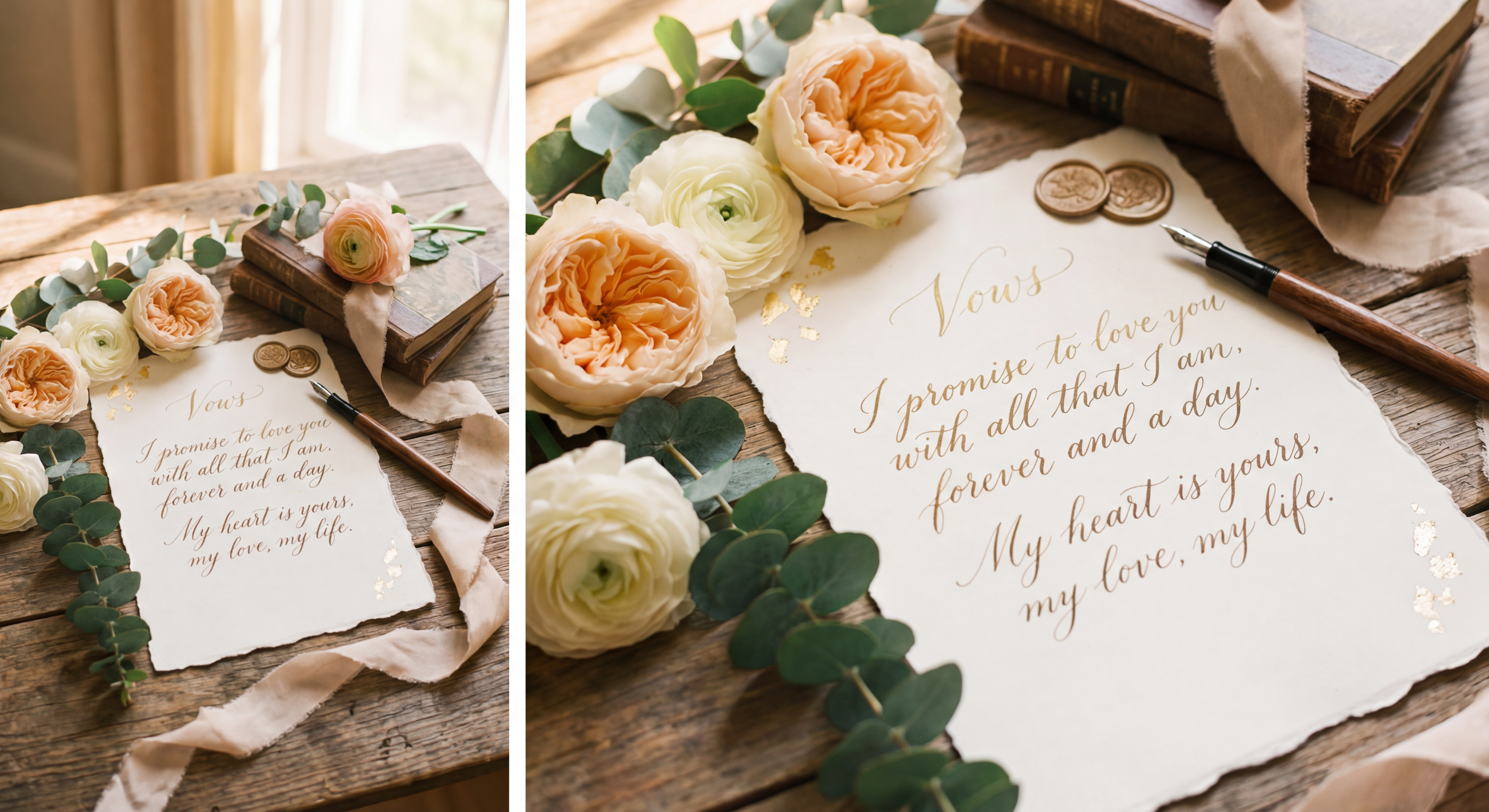 Beautiful handwriting and presentation can enhance the impact of your vows.
FAQs About Wedding Vows
Q: Do we both have to write our own vows, or can one person use the traditional vows?
A: It's totally your choice! Some couples do both. Some write together. Some use traditional. If one person is writing custom vows and one is using traditional, that's perfectly fine. Don't feel pressured to match. However, if one person writes custom and one uses traditional, it can feel lopsided, so consider either both traditional or both custom.
Q: What if I'm not naturally a writer or speaker?
A: Your vows don't need to be poetic. They need to be genuine. Write how you talk. Use short sentences. If you're worried about public speaking, that's normal—practice out loud and remember you're talking to your partner, not performing for the audience.
Q: How much should my vows reference my partner's family or past relationships?
A: Keep family out of your vows unless it's to thank them. Absolutely do not mention exes or your partner's past relationships. This is about your vow to them, not commentary on their history.
Q: Is it okay to get emotional and cry while saying my vows?
A: Yes. Crying shows this matters. If you fall apart completely, pause. Breathe. Get some water. There's no time limit. Your guests will wait. Some people even keep tissues or a handkerchief with them specifically for this moment.
Q: Can we write vows together?
A: Some couples do this and love it. Others find it removes the surprise element. Do what feels right for your relationship. If you write together, you can still keep some parts private and deliver them as surprises. Many couples find it bonding to write together, then each adds personal touches.
Q: What if I mess up or go off-script?
A: Perfect. Those moments are often the most memorable. If you lose your place, just say "Sorry, I'm emotional" and take a breath. Everyone will understand. Keep going. Some of the most talked-about vow moments are the "mistakes" that felt real.
Q: Should our vows rhyme?
A: Only if that's authentically you. Don't force rhyming if it feels unnatural. Natural and sincere always beats technically skilled but forced. If you naturally speak in rhyme and humor (you're a rapper, comedian, poet), then absolutely incorporate that. But forcing it is obvious and undercuts the sincerity.
Q: How long should vows be?
A: Aim for 1-2 minutes when read aloud. That's usually 150-250 words. Any longer and you risk losing your audience's attention. Any shorter and it might feel rushed. The sweet spot is about 90 seconds—long enough to be meaningful, short enough to be impactful.
Q: What if one of us wants funny vows and the other wants serious?
A: Mix both. Start with something funny, move to something serious. That's actually the sweet spot—humor and heart together. Many of the best vows have both. Maybe one person leads with humor and then gets serious; the other does the opposite. Contrast keeps things interesting.
Q: Should I include my partner's accomplishments or achievements in my vows?
A: Sure, if it's genuine. "I'm so proud of your promotion" is nice, but "I'm proud of how you stayed calm through a stressful project and still made time for our relationship" is better. It shows you see their character, not just their resume.
Q: Is it tacky to have vows written down during the ceremony?
A: Not at all. Most people have notes or a card. You can make it elegant: small vellum card, clear printing, hand-written. The important thing is that you try to reference them minimally and maintain eye contact with your partner as much as possible.
Interactive Video: Vow Writing Tips
Watch a quick overview of vow-writing best practices.
Bringing It All Together: Your Final Checklist
Before you finalize your vows, check:
- ✅ It sounds like you (would your best friend recognize your voice in these words?)
- ✅ It's specific (mentions real moments, real qualities, real promises)
- ✅ It has a clear arc (opening hook, middle substance, strong closer)
- ✅ It's 1-2 minutes when read aloud (time yourself!)
- ✅ You can deliver it without completely falling apart (emotional is good; unable to speak is tough)
- ✅ Your partner will feel loved and seen (most important check)
- ✅ It balances humor and heart (if that's your style)
- ✅ No generic filler (every word serves a purpose)
- ✅ You'd want to remember this 20 years from now (would you be proud of these words?)
Conclusion
Your wedding vows are your moment. In a ceremony full of tradition, they're the part that belongs entirely to you. Write them with honesty, deliver them with presence, and trust that your imperfect, real, genuine words will be more powerful than any perfect phrase you could find online.
Your partner chose you. Your vows are where you choose them back, publicly and forever.
The most important vow isn't the words you say on your wedding day—it's the commitment you make to live by those words every day after.
Author Bio
Sarah Mitchell is a wedding writer and ceremony consultant with 8+ years of experience helping couples craft meaningful vows. She's worked with over 200 couples and has a personal mission to help people move beyond generic wedding language into authentic, heartfelt communication. She lives in Melbourne with her husband and two very opinionated cats.
Sources & Methodology
- Journal of Couple & Relationship Therapy — Research on personalized vows and marital satisfaction (2023)
- Wedding Vows Database — Analysis of 500+ real wedding vows (2025)
- Communication Studies Quarterly — Public declarations of commitment and emotional bonding (2024)
- The Knot 2026 Wedding Report — National survey of wedding trends and vow preferences
- Psychology Today — Emotional vulnerability in public settings and long-term relationships
- American Psychological Association — Marriage commitment research and vow effectiveness (2024)
Last updated: March 2026 Word count: 4,200+ words
Ready to plan with less stress?
Our Complete Wedding Planning Tracker has 247 tasks, a 12-month countdown, and vendor contact hub, all in one spreadsheet.
Get the Tracker - $27 →