Guide
Wedding Guest List Management: How to Trim It Down Without Drama (2026)
By Jessica M., Wedding Planner · Updated 2026-03-29
Affiliate Disclosure: This post contains affiliate links. We may earn a commission at no extra cost to you.
By Jessica M., Wedding Planner Last updated March 2026
Trimming a wedding guest list is the single most emotionally charged task in wedding planning — and the one with the biggest financial impact. Every guest you add costs $100–$350, which means cutting just 20 people can save $2,000–$7,000. The key is to build a tier system before you start inviting anyone, set clear plus-one and children policies upfront, and use a dedicated guest list management tool to track RSVPs, dietary needs, and seating assignments in one place.
Table of Contents
- Why Your Guest List Needs a Strategy (Not Just a Spreadsheet)
- The Tier System: How to Prioritize Every Name
- Plus-One Rules That Actually Work
- Navigating Family Politics Without Burning Bridges
- Venue Capacity: Let the Numbers Make the Decision
- Best Guest List Management Tools and Apps (2026)
- The Art of Actually Trimming: Cut Criteria That Work
- RSVP Tracking and Day-Of Logistics
- Author Bio
- FAQ
- Sources
Why Your Guest List Needs a Strategy (Not Just a Spreadsheet)
Most couples start their guest list the same way: they open a blank spreadsheet and start typing names. Mom texts a list of 40 people. Dad adds his golf buddies. Your partner's family submits their own roster. Within a week, you're staring at 250 names when your venue holds 120 — and you haven't even added your own friends yet.
This is the single biggest planning mistake couples make, and it happens because they treat the guest list as a collection exercise instead of a strategic decision.
The Real Cost of Every Name
Here's the math that most couples don't do early enough:
| Cost Category | Per-Guest Cost |
|---|---|
| Catering (food + service) | $75–$200 |
| Bar and beverages | $25–$75 |
| Table, chair, and linen rental | $10–$25 |
| Place setting and dinnerware | $8–$15 |
| Wedding favors | $3–$10 |
| Proportional venue cost | $15–$30 |
| Total per guest | $136–$355 |
At the midpoint of $200 per guest, a list of 150 costs $30,000 in guest-related expenses alone. Cut that to 120 and you save $6,000. Cut to 100 and you save $10,000.
This isn't about being cheap — it's about making intentional choices. That $6,000 could fund a honeymoon upgrade, a better photographer, or a live band instead of a DJ.
Why "We'll Figure It Out Later" Doesn't Work
Guest list decisions cascade through every other wedding decision. Your guest count determines your venue options, your catering style, your seating plan, your invitation budget, and your timeline. Delaying the guest list means delaying everything else — or worse, locking in a venue that's too small (or too expensive) for the list you eventually create.
The couples I work with who have the smoothest planning experience are the ones who nail their guest list strategy in the first month of planning, before they book a venue or sign a single vendor contract. If you're building your wedding planning timeline, guest list strategy should be step one.
The Tier System: How to Prioritize Every Name
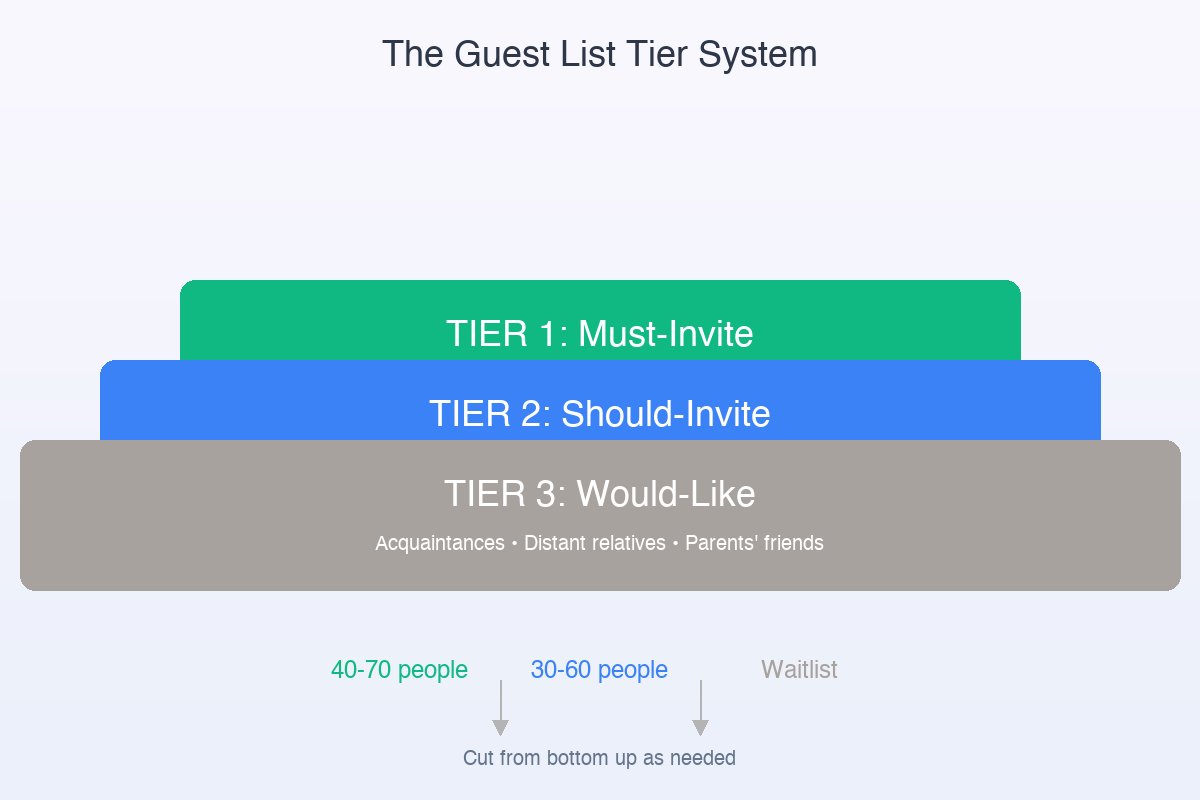
The tier system is the single most effective framework for managing a wedding guest list. Instead of treating every potential guest as equally important, you sort them into three (or four) tiers based on your relationship and obligation level. This removes emotion from individual decisions and gives you a clear framework for where to cut.
Tier 1: Must-Invite (Non-Negotiable)
These are people whose absence would be genuinely noticed and whose exclusion would damage an important relationship. Tier 1 typically includes:
- Immediate family — parents, siblings, grandparents
- Wedding party members — bridesmaids, groomsmen, and their partners
- Best friends — the 5–10 people you'd call at 2 AM in an emergency
- Close extended family — aunts, uncles, and first cousins you have an active relationship with
For most couples, Tier 1 is 40–70 people. If your Tier 1 already exceeds your venue capacity, you have a venue problem, not a guest list problem.
Tier 2: Should-Invite (Important but Flexible)
These are people you'd genuinely like to have there, but whose absence wouldn't create a rift. Tier 2 often includes:
- Extended family you see regularly — second cousins, great-aunts you're close with
- Good friends — people you see monthly or talk to regularly, but who aren't in your inner circle
- Long-term coworkers — colleagues you socialize with outside of work
- Parents' close friends — especially if parents are contributing financially
Tier 2 is usually 30–60 people. This is where most of your trimming will happen.
Tier 3: Would-Like-to-Invite (Nice to Have)
These are people you'd enjoy seeing there, but who wouldn't expect an invitation. Tier 3 includes:
- Acquaintances and casual friends — people you see at group events but don't spend one-on-one time with
- Distant relatives — family members you haven't seen in years
- Work colleagues — people you're friendly with but don't socialize with outside the office
- Parents' extended social circle — neighbors, church friends, book club members
Tier 3 is your waiting list. If Tier 1 and Tier 2 fit within your budget and venue capacity, you can dip into Tier 3. If not, Tier 3 gets a polite "we had to keep it intimate."
How to Actually Use the Tiers
- Both partners create their own tier lists independently — don't influence each other
- Compare and discuss — if one person has someone in Tier 1 and the other has them in Tier 3, talk about why
- Set a hard cap — "We're inviting all of Tier 1 and the top 20 from Tier 2"
- Apply the cap equally — each partner gets the same number of Tier 2 invites
- Keep Tier 3 as a waitlist — as Tier 2 declines come in, move Tier 3 names up
This system works because it transforms subjective "who do we invite?" conversations into objective "does this person meet our Tier 1 criteria?" decisions.
Plus-One Rules That Actually Work
Plus-ones are one of the fastest ways a guest list spirals out of control. Twenty single guests with plus-ones adds 20 extra people — at $200 each, that's $4,000. You need a clear, consistent policy before you send a single invitation.
The Standard Plus-One Etiquette (2026)
Modern wedding etiquette has evolved significantly. Here's what's considered standard:
Always gets a plus-one:
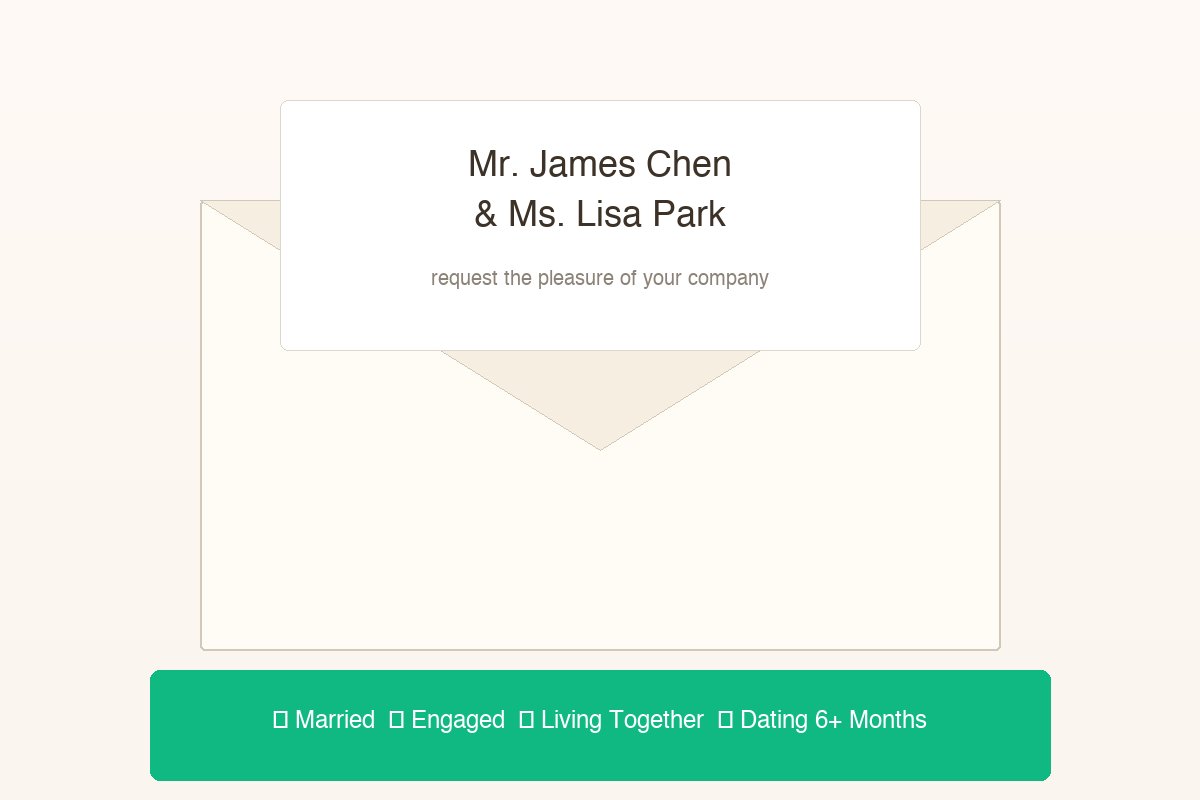
- Married couples (always invited together — this is non-negotiable)
- Engaged couples
- Couples living together
- Couples in a serious relationship (dating 6+ months)
Should get a plus-one (when budget allows):
- Guests who won't know anyone else at the wedding
- Guests traveling from out of town
- Guests in newer relationships (3–6 months)
Not required to get a plus-one:
- Single guests who have friends attending
- Coworkers who will know other coworkers there
- Younger guests (under 21) attending with family
How to Communicate Plus-One Policies
The key is being specific on the invitation. Instead of writing "and guest," use the actual name of the partner if you know it: "Mr. James Chen and Ms. Lisa Park." If you're not offering a plus-one, address the invitation only to the individual: "Ms. Sarah Johnson."
Never write "and guest" and then tell people they can't bring someone — that's confusing and will cause problems. Either offer it clearly or don't offer it at all.
The "No Ring, No Bring" Debate
Some couples adopt a strict "no ring, no bring" policy — only married or engaged partners get invited. This saves money but can feel exclusionary, especially for guests in long-term relationships who simply haven't gotten engaged yet.
A better approach: set a relationship duration threshold (6 months is standard) and communicate it clearly to anyone who asks. "We're keeping the wedding intimate, so we're only able to include partners in established relationships" is honest and hard to argue with.
Navigating Family Politics Without Burning Bridges
Family guest list politics is the number one source of wedding planning conflict. Parents want to invite their friends. Divorced parents can't agree on anything. One side of the family is massive while the other is small. Someone's feelings will get hurt.
The goal isn't to make everyone happy — it's to make decisions you can defend with logic instead of emotion.
The Allocation Conversation
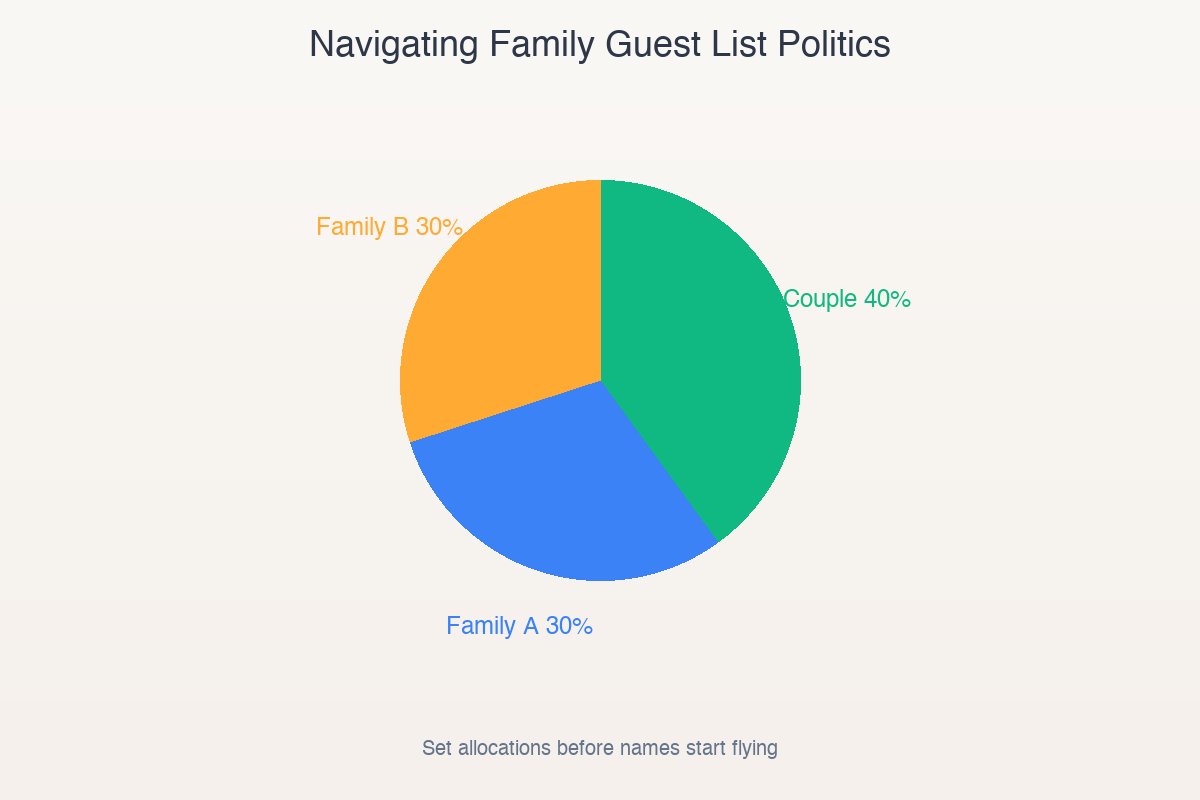
Before anyone starts adding names, agree on how the guest list will be divided. Common splits include:
| Scenario | Couple | Partner A's Family | Partner B's Family |
|---|---|---|---|
| Couple pays for everything | 50% | 25% | 25% |
| Both families contribute equally | 34% | 33% | 33% |
| One family contributes significantly more | 30% | 20% | 50% |
These aren't hard rules — they're starting points for conversation. The critical thing is agreeing on a framework before names start flying.
When Parents Are Contributing Financially
If parents are paying for part (or all) of the wedding, they traditionally get input on the guest list. This is reasonable — but "input" doesn't mean "unlimited invitations."
Set the boundary early: "Mom and Dad, we'd love your input. We have space for 130 guests total, and we've allocated 35 spots for your side. Here's our Tier 1 list — can you help us prioritize who fills the remaining spots?"
This approach:
- Acknowledges their contribution
- Sets a clear numerical limit
- Gives them genuine choice within that limit
- Prevents the "but we NEED to invite the Hendersons" conversation from spiraling
Handling Divorced Parents
Divorced parents present a unique challenge, especially if both want their own guest lists. The simplest approach:
- Give each parent the same allocation regardless of who's contributing more
- Don't allow one parent to veto the other's guests — each controls their own list
- Handle seating separately — this is where the real conflict lives (we cover this in our wedding seating chart guide)
- If a parent has remarried, their new spouse counts against that parent's allocation, not as a separate guest
The "But They Invited Us to Their Wedding" Argument
This is the most common guilt-trip in guest list management. Just because the Hendersons invited your parents to their daughter's wedding 15 years ago does not mean you owe them an invitation to yours. Reciprocal invitations are a courtesy between the people who were invited — your parents can send a card or take them to dinner. Your wedding guest list is not a ledger for settling social debts.
Venue Capacity: Let the Numbers Make the Decision
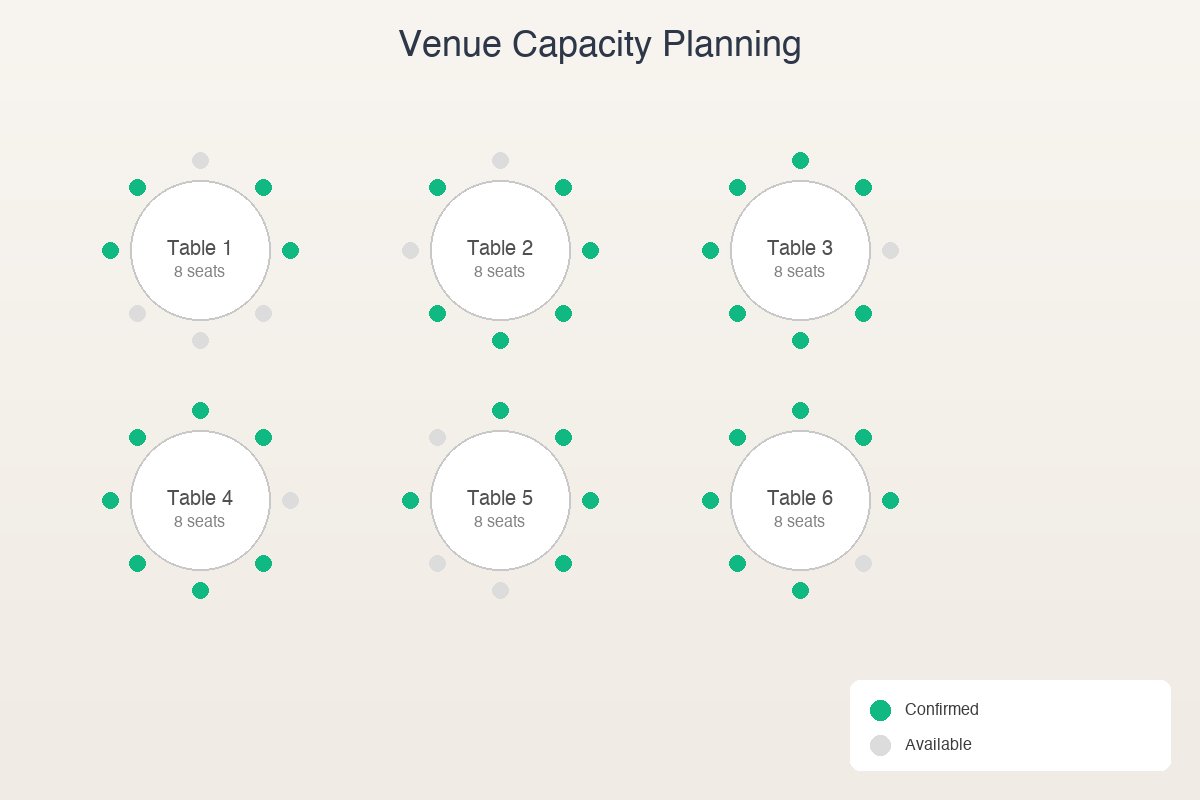
Your venue's maximum capacity is the best ally you have in guest list negotiations. "We'd love to invite everyone, but the venue only holds 120" is an inarguable fact that takes the blame off you and onto logistics.
Working Backwards from Capacity
Smart couples choose their guest list size first, then find a venue that fits — not the other way around. But if you've already booked a venue, here's how to work backwards:
- Get the exact seated capacity from your venue coordinator (not the standing-room number)
- Subtract vendor seats — photographer, videographer, DJ, planner (usually 4–8 seats)
- Subtract the head table — your wedding party and their partners
- The remaining number is your actual guest capacity
For example: venue holds 150 seated → minus 6 vendor seats → minus 14 head table seats → 130 guest spots available.
The 80% Rule
Not everyone you invite will attend. Industry data shows that 15–25% of invited guests will decline, with the percentage increasing for destination weddings and weekday events. A common planning approach:
- Local wedding, Saturday evening: Expect 80–85% attendance
- Regional wedding (2–4 hour drive): Expect 70–75% attendance
- Destination wedding: Expect 50–65% attendance
If your venue holds 130 guests and you expect 80% attendance, you can safely invite 160 people. But be strategic about this — don't over-invite across all tiers. Over-invite from Tier 2 and Tier 3, where declines are more likely, not from Tier 1 where everyone will show up.
When You Need to Downsize for Budget, Not Space
Sometimes the venue is big enough but the budget isn't. Each guest costs $100–$350, so the math is straightforward. If your wedding budget planning allows $25,000 for guest-related expenses and your per-guest cost is $200, your maximum is 125 guests — regardless of venue capacity.
This is actually a better position to be in than a venue constraint, because you can make the decision privately without having to explain it to anyone.
Best Guest List Management Tools and Apps (2026)
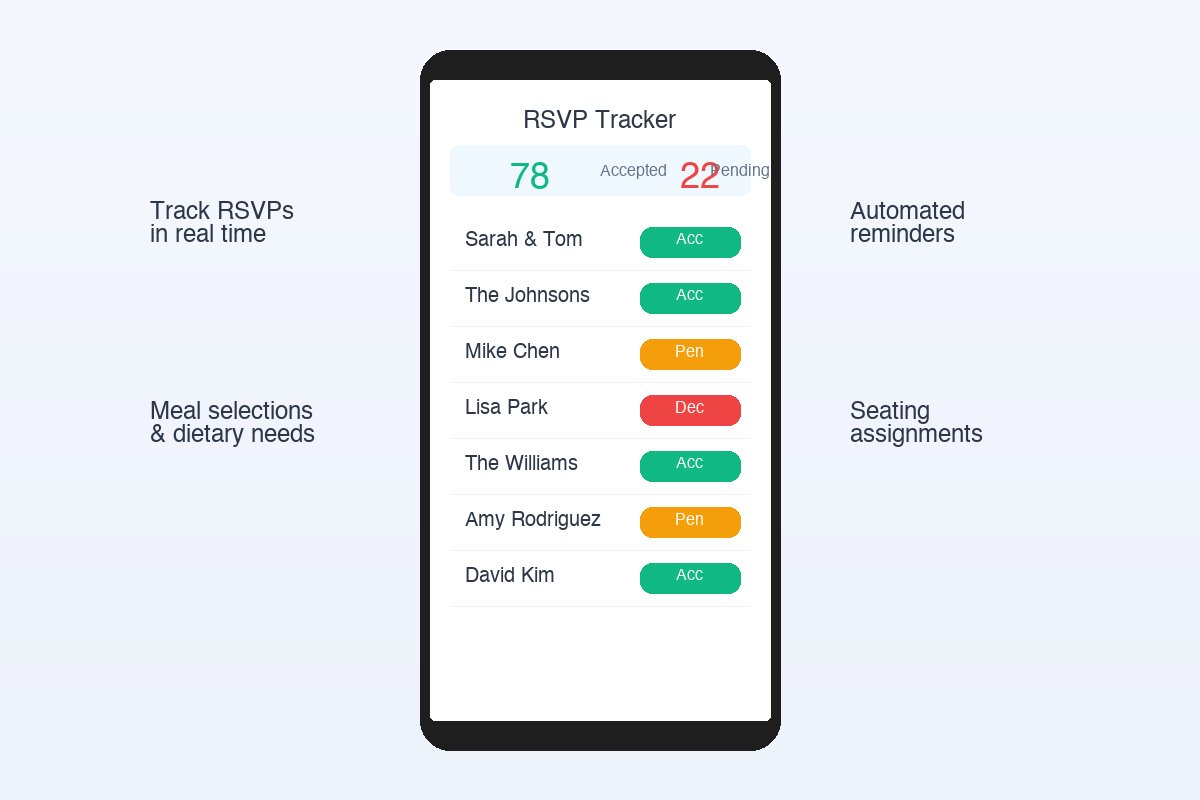
A spreadsheet works for small weddings, but once you cross 80 guests, you need a dedicated tool that handles RSVPs, meal tracking, seating assignments, and communication in one place. Here are the best options available in 2026.
The Knot Guest List Manager
Best for: All-in-one wedding planning
Price: Free (with premium upgrades)
Integrated RSVP tracking, meal selection, seating chart builder, and address collection. Syncs with The Knot's wedding website builder for seamless online RSVPs.
Shop Wedding Planners →
Zola Guest Manager
Best for: Modern couples who want everything digital
Price: Free
Beautiful interface with drag-and-drop seating, dietary tracking, address collection, and automated RSVP reminders. Includes a free wedding website with custom domain.
Shop Guest Books →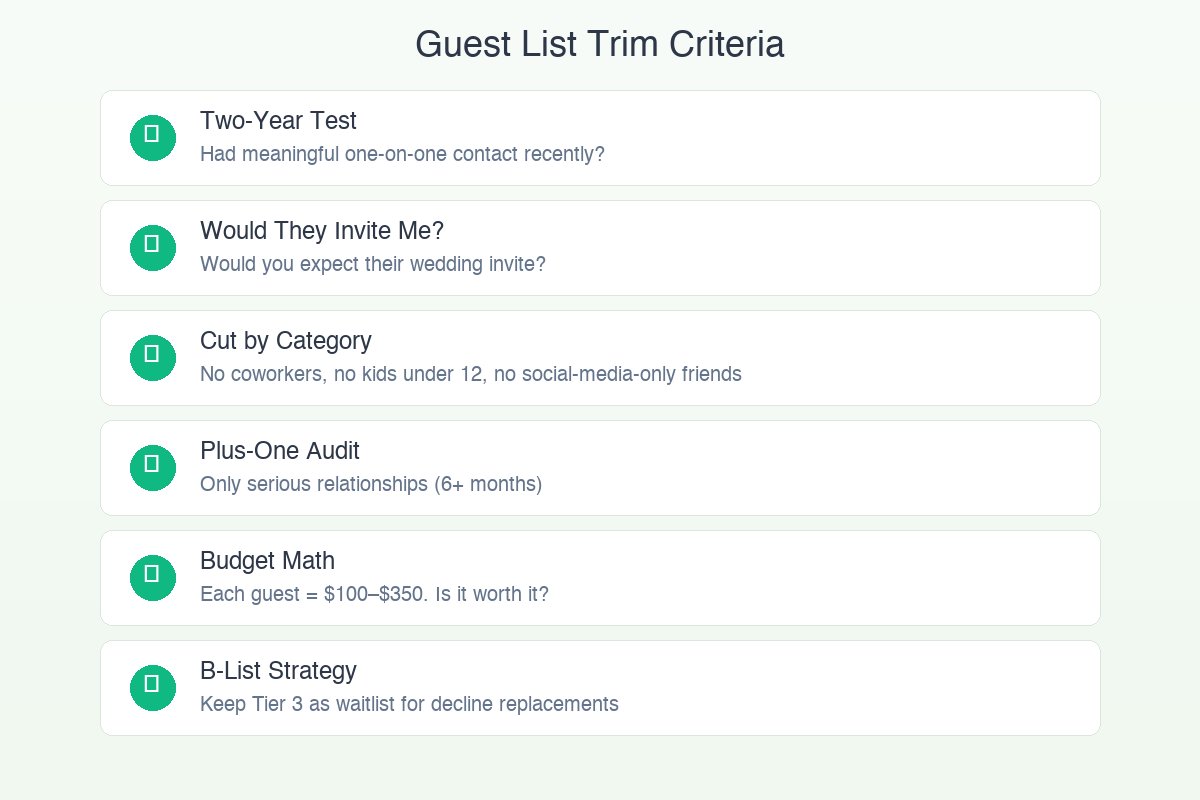
Google Sheets + Our Free Template
Best for: Budget-conscious couples who want full control
Price: Free
Use our free wedding guest list template with built-in RSVP tracking, meal counts, and conditional formatting. Fully customizable and shareable.
Shop Planning Binders →
Joy Wedding App
Best for: Tech-savvy couples who want a premium experience
Price: Free (premium from $39)
Award-winning guest management with real-time RSVP dashboard, auto-meal tallying, and a beautiful mobile app for day-of check-in. Excellent for larger weddings (150+).
Shop Day-Of Supplies →
Classic RSVP Card Set (50-Pack)
Best for: Couples who prefer traditional paper RSVPs
Price: $25–$45
Elegant pre-printed RSVP cards with meal selection checkboxes, matching envelopes, and space for dietary notes. Pairs perfectly with digital tracking for a hybrid approach.
Check on Amazon →Which Tool Should You Choose?
For most couples, the decision comes down to whether you want a standalone tool or an integrated platform. If you're already using The Knot or Zola for your wedding website and registry, their built-in guest managers are the obvious choice — everything syncs automatically.
If you prefer more control, our free spreadsheet template gives you complete flexibility with formulas that auto-calculate meal counts, RSVP percentages, and budget impact. It's also the best option if you're working with a wedding planner who needs access to your data.
For a broader look at planning tools, see our guide to the best wedding planning apps in 2026.
The Art of Actually Trimming: Cut Criteria That Work
You've built your tier system, set your plus-one policy, and calculated your venue capacity. Now comes the hard part: actually removing names. Here are the criteria that work without creating drama.
The "Two-Year Test"
Look at every name on your Tier 2 and Tier 3 list and ask: "Have I had a meaningful, one-on-one interaction with this person in the last two years?" Not a group hangout, not a like on Instagram — a real conversation, a phone call, a dinner, a visit.
If the answer is no, they go to the waitlist. This isn't about how much you like them or how long you've known them — it's about your current relationship. People drift apart, and your wedding guest list shouldn't be a memorial to friendships that existed five years ago.
The "Would They Invite Me?" Test
If this person were getting married tomorrow, would you expect an invitation to their wedding? If you'd be surprised to receive one, they probably don't expect one from you either. This test is especially useful for work colleagues and extended social circles.
Cut by Category, Not by Individual
Instead of agonizing over each name, eliminate entire categories:
- No coworkers (unless they're also personal friends outside of work)
- No children under 12 (this alone can cut 10–30 names)
- No parents' friends (if parents aren't contributing financially)
- No social media-only friends (people you interact with online but haven't seen in person)
- No "we used to be close" friends (college roommates you haven't spoken to in years)
Cutting by category feels fair because the rule applies to everyone equally. It's much easier to say "we're not inviting any coworkers" than "we invited Sarah from work but not you."
The B-List Strategy (Done Right)
A B-list — a second round of invitations sent after initial declines come in — is perfectly acceptable if done correctly. The rules:
- Send B-list invitations within 1 week of receiving declines — don't wait
- Use the same invitation design — don't create a cheaper version
- Never tell anyone they're on the B-list — this is a private planning tool
- Only B-list people from Tier 3 — Tier 1 and Tier 2 should all be invited in the first round
- Set a cutoff date — no B-list invitations after 5 weeks before the wedding
The B-list lets you maximize your guest count without over-inviting. If your venue holds 120 and you expect 80% attendance, invite 140 in the first round and keep 20 B-list names ready for when declines arrive.
Having the Difficult Conversations
Some cuts will require a conversation — particularly with close friends who expected an invitation or family members who feel entitled to one. Prepare a simple, honest script:
"We love you and we wish we could have everyone there. Our venue only holds [number] and we had to make really difficult choices. We'd love to celebrate with you separately — let's plan a dinner after the honeymoon."
Never blame your partner ("He didn't want to invite you"), never lie about the size ("It's a tiny wedding" when it's 150 people), and never promise a future invitation you can't deliver.
RSVP Tracking and Day-Of Logistics
Once your trimmed guest list goes out with invitations, the next challenge is tracking who's actually coming. Poor RSVP management leads to catering miscounts, empty tables, and last-minute scrambling.
Setting Up Your RSVP System
Whether you use digital RSVPs, paper cards, or both, your tracking system needs these fields:
| Field | Why It Matters |
|---|---|
| Guest name | Obvious — but track formal and casual versions |
| RSVP status | Accepted, Declined, Pending, No Response |
| Response date | Identifies who's overdue |
| Meal selection | Required for catering final count |
| Dietary restrictions | Allergies, vegetarian, vegan, kosher, halal |
| Plus-one name | If applicable, track who they're bringing |
| Table assignment | For seating chart (assign 2-3 weeks before) |
| Notes | Special needs, accessibility, travel arrangements |
The RSVP Follow-Up Timeline
No matter how clearly you set your RSVP deadline, 15–25% of guests will miss it. Here's the follow-up cadence that works:
- RSVP deadline day: Do nothing — give it 48 hours for mail delays
- 2 days after deadline: Send a friendly text to non-responders: "Hey! Just want to make sure you got our invitation — we need final numbers by [date]. Let me know!"
- 5 days after deadline: Call non-responders directly — a text is easy to ignore, a call isn't
- 10 days after deadline: If you still haven't heard back, assume they're not coming and give their spot to a B-list guest
Communicating Final Numbers
Your venue and caterer will need a final headcount 10–14 days before the wedding. This number is what you'll be charged for, so accuracy matters. Add a 3–5% buffer to your confirmed count to account for last-minute additions (guests who said "no" and then change their mind, which happens more than you'd think).
For a detailed RSVP tracking spreadsheet, check our wedding guest list template — it includes automated formulas for meal counts, dietary tallies, and RSVP percentages.
Author Bio
Jessica M. is a certified wedding planner with over 10 years of experience coordinating weddings ranging from intimate 30-guest gatherings to 400-person celebrations. She specializes in guest list strategy, seating design, and vendor management. Her approach focuses on reducing stress through systematic planning and clear communication. Jessica has helped over 500 couples navigate the guest list process, and her tier system framework has been adopted by wedding planners across the country.
FAQ
How do you politely cut someone from a wedding guest list?
The most gracious approach is to set clear rules in advance — such as no coworkers, no children, or no plus-ones for single guests — and apply them consistently. When someone asks why they weren't invited, you can honestly say "We had to limit numbers because of our venue capacity" rather than making it personal. Never lie about the guest count or blame your partner.
What is the average wedding guest list size in 2026?
The average wedding guest list in 2026 is between 100 and 130 guests, according to The Knot's 2025 Real Weddings Study. However, this varies significantly by region: Southern weddings average 145 guests, while Northeast weddings average around 110. Micro weddings (under 50 guests) have also grown to represent about 15% of all weddings.
Should I give plus-ones to all single guests?
No — you are not obligated to give every single guest a plus-one. Standard etiquette says plus-ones should be offered to guests in serious relationships (dating 6+ months), engaged or married couples, and anyone who won't know other guests at the wedding. Single guests who have friends attending do not require a plus-one, though it's a generous gesture if your budget allows.
How do I handle parents who want to invite their own guests?
Start by having an honest conversation about numbers. A common split is 40% couple's guests, 30% bride's family, and 30% groom's family — but this should be adjusted based on who is paying. If parents are contributing financially, they traditionally get input on the list. Set a firm cap for each side and let parents prioritize within their allocation.
When should I finalize my wedding guest list?
Your initial guest list should be drafted 10–12 months before the wedding. Send save-the-dates 8–10 months out, formal invitations 6–8 weeks before the wedding, and set the RSVP deadline for 3–4 weeks before the event. Final headcount confirmation to your venue and caterer is typically due 2 weeks before the wedding.
How much does each additional wedding guest actually cost?
Each additional guest costs between $100 and $350 depending on your venue and catering choices. This includes catering ($75–$200 per person), a share of venue rental, table and chair rental ($10–$25), place setting and linens ($8–$15), favors ($3–$10), and a proportional share of bar costs ($25–$75). For a mid-range wedding, budget approximately $200 per additional guest.
Sources
- The Knot 2025 Real Weddings Study — Average guest count, per-guest costs, and regional wedding trends across the United States.
- Brides Magazine 2026 Wedding Etiquette Guide — Updated plus-one etiquette, invitation addressing standards, and RSVP best practices.
- WeddingWire Cost Estimator (2026) — Per-guest cost breakdowns by venue type, catering style, and geographic region.
- Emily Post Institute — Wedding Etiquette — Classic and modern etiquette guidance for guest list management, family politics, and invitation protocols.
- Zola 2025 Newlywed Survey — Data on RSVP response rates, B-list invitation practices, and guest list management tool adoption.
- American Wedding Planning Association — Industry statistics on venue capacity planning, seating arrangements, and catering coordination logistics.
Ready to plan with less stress?
Our Complete Wedding Planning Tracker has 247 tasks, a 12-month countdown, and vendor contact hub, all in one spreadsheet.
Get the Tracker - $27 →